

Telescope Specification
Optics, mechanics, autoguider, enclosure and site
Optics
The Liverpool Telescope is a two-metre Ritchey-Chrétien Cassegrain reflector, with an f/10 focus at the Cassegrain. Light is collected by the primary mirror and directed through an Acquisition & Guidance (A&G) box, where a deployable "science fold" mirror can select any of the instrument ports.
Primary Mirror
- Diameter
- 2.0 m
- Focal ratio
- f/3
- Central bore
- 0.45 m
Secondary Mirror
- Diameter
- 0.62 m
- Focus
- Moves axially
- Cassegrain
- f/10
Image Scales
- Prime focus
- 29.1 µm/arcsec
- Cassegrain
- 97 µm/arcsec
Instrument ports & through port
The A&G box at the Cassegrain focus provides one straight-through port and four science-fold ports. The deployable science-fold mirror sits at 45° to the optical axis and rotates around it to reach all four side ports.
- Through-port clear aperture: 40 arcmin field of view
- Field curvature radius: −1773 mm (correctable to a plane surface with an optional wide-field corrector lens, not currently fitted)
Autoguider
The autoguider allows closed-loop tracking of the telescope, correcting tracking errors by monitoring a guide star. It is based around an Andor Technology DV435 frame-transfer camera, running under a custom control system that performs dark subtraction, flat-fielding and object detection on each frame.
The system operates over a fixed set of exposure lengths from 50 ms to 10 s, with a nominal 100×100-pixel guide window. Guide centroids are sent to the Telescope Control System, which applies the correction — you do not need to pick your own guide star. As there is a single autoguider, only translational tracking errors are corrected; rotational errors are not.
Andor DV435 camera
- Active pixels
- 1024 × 1024
- Pixel scale
- 0.22 arcsec/px
- Pixel size
- 13 × 13 µm
- Peak Q.E.
- 95 %
- Operating temp.
- −40 °C
- Readout rate
- 1 MHz
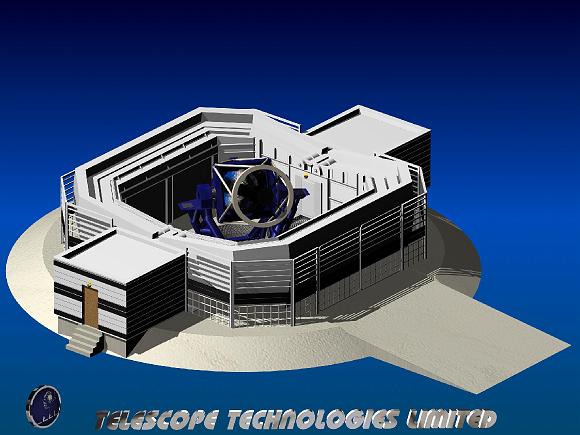
Mechanics
- Alt/az mount with a steel-tube, conventional open-truss Serrurier design
- Friction-free hydrostatic bearings
- Slew rate of 2°/sec on all axes; altitude range 21–88°
- Zenith avoidance zone of 2° radius (set by the maximum velocity & acceleration of the alt/az servos)
- Active primary-mirror support — the 1.35-tonne mirror is dynamically held by axial & lateral pneumatic actuators
- Motion control by embedded x86 industrial PCs on and off the mount, with control data distributed system-wide in real time over a switched network
- A services PLC controller provides real-time monitoring of the telescope, interlocks and hydraulics
Observatory Building
The observatory site consists of two buildings.
Telescope building
- The enclosure which houses the telescope
- The pump room — hydraulic and pneumatic systems for the telescope and enclosure
- The computer / IT room — all computing systems for the observatory
The Annexe building
- Site office
- Electronics workshop & storage
- Mechanical workshop
The clamshell enclosure
The enclosure is a novel clamshell design, consisting of two shutters, each comprising three separate portals. To open, two hydraulic rams at either end retract, allowing the top portals to move down while the other portals follow dynamically. Fully open, the telescope has an unencumbered view to an optical horizon of 21° altitude (its mechanical horizon being 20°). Opening the enclosure takes approximately three minutes.
The entire observatory structure was designed by TTL and built by Cammell-Laird in Birkenhead, the famous Merseyside shipbuilding company. The hydraulic ram system was designed and built by Hydraul SYD (now PMC Hydraulics) of Sweden.
Site Location
Contrary to what the name might suggest, the Liverpool Telescope is not in Liverpool but on the island of La Palma, the westernmost of the Canary Islands — a group of volcanic islands 200–300 km off the northwest coast of Africa.
The island's most distinctive feature is the enormous Caldera de Taburiente, the eroded remains of a volcano that collapsed two million years ago — the largest caldera in the world. The highest point on its rim (2426 m) is the Roque de Los Muchachos ("Rock of the Little Children"). The Roque is one of the best observing sites in the world, and is home to many European observatories under the umbrella of the Observatorio del Roque de Los Muchachos (ORM).
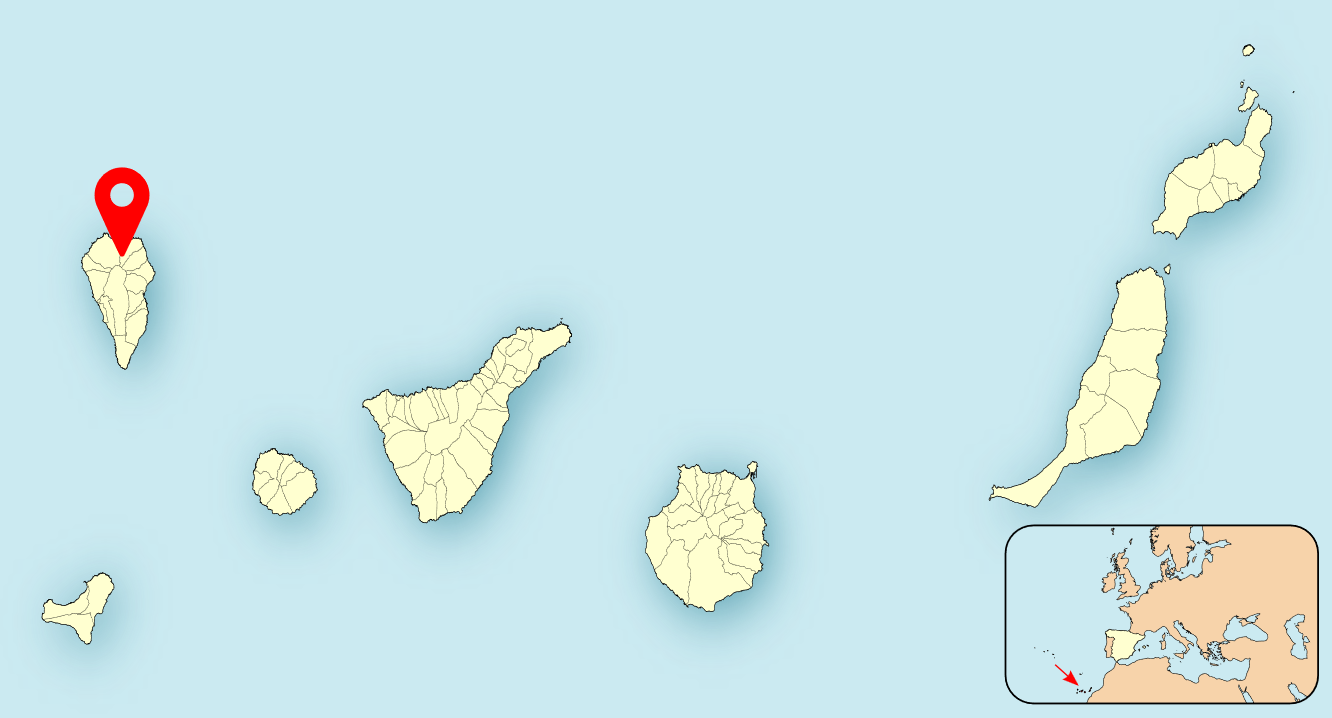
Coordinates (WGS84)
| Format | Latitude (north) | Longitude (west) | Longitude (east) |
|---|---|---|---|
| DMS | 28° 45′ 44.8″ | 17° 52′ 45.2″ | 342° 07′ 14.8″ |
| DM | 28° 45.747′ | 17° 52.753′ | 342° 07.247′ |
| Decimal | 28.7624° | 17.8792° | 342.1208° |
Altitude: 2363 metres (7753 feet / 1.47 miles).
Explore more
Read about the telescope and its science, or apply for observing time.
About the LT Phase 1 Proposals